

Bookcase Stability Simulator
Adjust Parameters
Adjust sliders to see impact.
Nothing ruins a quiet evening faster than the terrifying sound of a tall piece of furniture tipping over. If you have a freestanding bookcase, especially one that is narrow and tall, you are likely living with a hidden hazard. A standard 6-foot-tall unit can become unstable the moment you load it with heavy hardcovers or lean against it while reaching for a top shelf. The good news? You don't need to throw your favorite furniture out or buy a new built-in unit. With a few simple tools and the right techniques, you can make your freestanding bookcase rock-solid in under an hour.
Most modern bookcases are designed to look sleek and minimal, which often means they lack the deep back panels or heavy base weights that older furniture had. This design choice makes them prone to wobbling and tipping. Understanding why this happens is the first step to fixing it. Once you know the physics at play, the solutions become much easier to implement. Whether you are renting or owning your home, there are safe and effective ways to secure your shelves without damaging the walls permanently.
Why Tall Bookcases Tip Over
To fix the problem, you first need to understand the mechanics. A freestanding bookcase is essentially a lever. The center of gravity sits low when the shelves are empty, but as you add weight-especially to the upper shelves-the center of gravity shifts upward. When the center of gravity moves beyond the footprint of the base, the unit tips. This is why a full bookcase feels wobbly even if the floor is level.
Several factors contribute to this instability:
- Height-to-width ratio: Units taller than three times their width are inherently less stable.
- Weight distribution: Placing heavy items on top creates a torque force that pulls the case forward.
- Floor conditions: Uneven floors or soft carpeting reduce the friction needed to keep the base planted.
- Construction quality: Loose joints or missing back panel screws weaken the structural integrity.
If your bookcase has a thin back panel or no back panel at all, it is even more susceptible to racking (diagonal shifting) when pushed. This isn't just about aesthetics; it's a serious safety risk, particularly in homes with children or pets who might climb on the furniture.
Method 1: Using Anti-Tip Straps and Kits
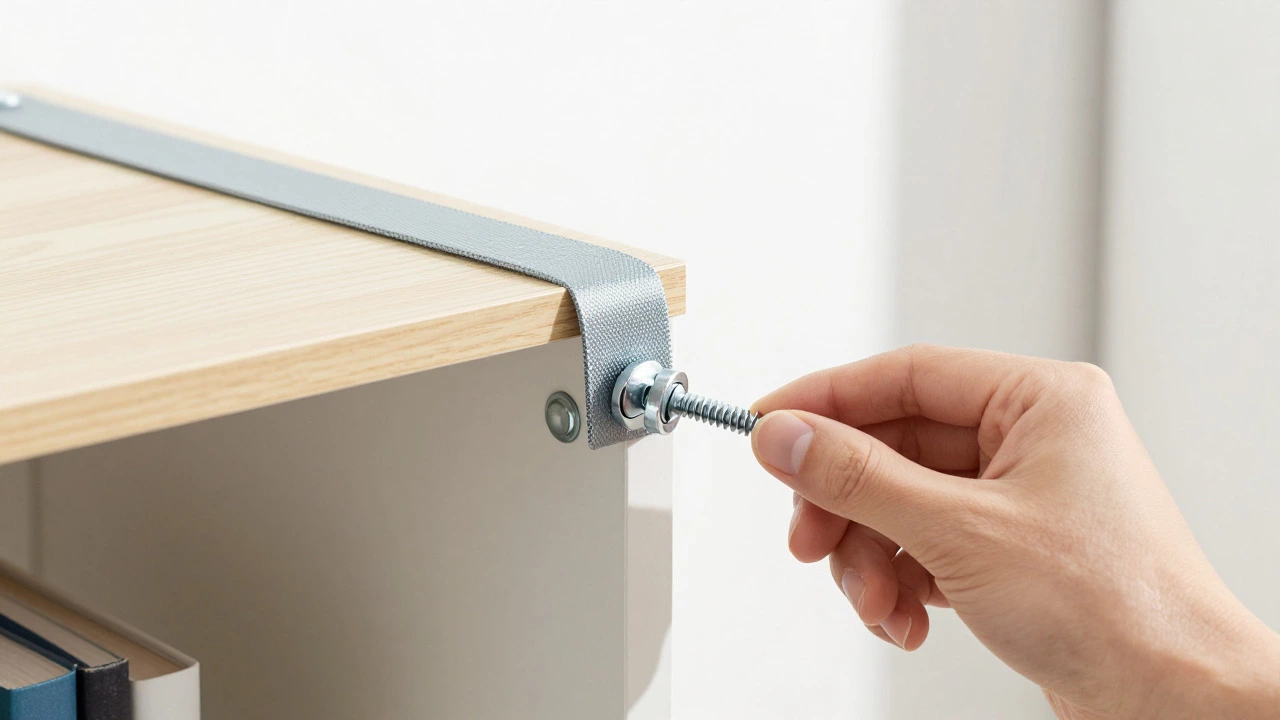
The most common and accessible solution is using an anti-tip strap or kit. These devices connect the top of the bookcase to the wall stud behind it. They are inexpensive, easy to install, and highly effective. There are two main types: metal straps with a turnbuckle and plastic L-brackets.
Metal straps offer more adjustability. You attach one end to the wall stud using lag bolts and the other end to the back of the bookcase. By turning the central screw, you can tighten the strap until the bookcase is pulled firmly against the wall. This eliminates any gap between the furniture and the drywall, preventing it from moving independently.
Plastic L-brackets are simpler but require precise drilling. You drill into the wall stud and the back of the bookcase simultaneously. While sturdy, they are harder to remove if you ever move the furniture. For renters, metal straps are generally preferred because they leave fewer marks and are easier to uninstall.
Method 2: Securing to Wall Studs with L-Brackets
If you own your home and want the most permanent solution, L-brackets are the gold standard. These are metal brackets shaped like an 'L' that screw into both the wall stud and the side or back of the bookcase. Because they are rigid, they prevent any movement whatsoever.
Installing L-brackets requires finding the studs. Use a stud finder to locate the vertical wooden supports inside your wall. Mark the position where the top of the bookcase meets the wall. Drill pilot holes into the stud and the corresponding point on the bookcase frame. Secure the bracket with wood screws on the bookcase side and lag bolts on the wall side. Lag bolts provide significantly more holding power than standard drywall anchors, making this method ideal for very heavy loads.
For extra stability, use two brackets-one on each side of the bookcase. This prevents the unit from twisting or leaning to one side. It’s important to ensure the bookcase is perfectly plumb (vertical) before tightening the final bolts. Use a level tool to check this. Once secured, the bookcase becomes effectively part of the wall structure.
Method 3: The Weight Distribution Strategy
Even with hardware installed, how you load your bookcase matters immensely. A well-secured unit can still feel wobbly if the weight is poorly distributed. The golden rule of bookcase loading is: heavy items go on the bottom, light items go on top.
Think of your bookcase like a pyramid. The base needs to be heavy to lower the center of gravity. Place encyclopedias, large hardcovers, and decorative stone objects on the lowest shelves. As you move up, transition to paperbacks, magazines, and lighter decorative items. This natural tapering keeps the center of gravity low and centered within the base footprint.
Avoid placing all the weight on one side. If you have a row of heavy books on the left and nothing on the right, the bookcase will lean. Distribute the weight evenly across the width of the unit. If you notice a slight lean, add a small bag of sand or a stack of books to the opposite side to counterbalance it. This simple adjustment can eliminate up to 50% of perceived wobble without any hardware.
Method 4: Floor-Level Stabilization
Sometimes the issue isn't the height, but the contact with the floor. Carpeted floors compress, causing the bookcase to shift slightly with every step. Hardwood or tile floors can also be uneven. To address this, you can use adjustable feet or leveling pads.
If your bookcase has fixed legs, you can place felt pads or rubber caps underneath them. This increases friction and prevents sliding. For more significant unevenness, use self-leveling shims. These are small, wedge-shaped pieces that you slide under the leg until the bookcase stands level. Check the level again after adding shims. A level bookcase distributes weight evenly, reducing stress on the joints.
In rental situations where you cannot drill into walls, consider using tension rods. Install a tension rod between the ceiling and the floor behind the bookcase, then attach a strap from the bookcase to the rod. This creates a temporary anchor point that doesn't require drilling into the wall surface itself. It’s a clever hack for those who need stability but fear damage deposits.

Common Mistakes to Avoid
Many people try to stabilize bookcases using methods that actually make things worse. Here are the pitfalls to watch out for:
- Using only drywall anchors: Drywall anchors are not strong enough to hold a heavy bookcase if it tips. Always aim for studs if possible. If you must use drywall, use toggle bolts, but treat this as a backup, not a primary solution.
- Tightening straps too much: Over-tightening an anti-tip strap can warp the back panel of the bookcase, leading to gaps and dust accumulation. Tighten until firm, not until the wood creaks.
- Ignoring the back panel: Many flat-pack bookcases come with a thin particleboard back. Ensure all screws securing this panel are tight. A loose back panel reduces rigidity by up to 30%. Re-screwing these points is a free and immediate fix.
- Leaning on the case: Habits matter. If you constantly lean on the bookcase while reading or cleaning, you are working against the stabilizing hardware. Try to break this habit or use a separate chair for support.
Maintenance and Long-Term Care
Stabilization is not a one-time event. Over time, screws can loosen, and straps can stretch. Every six months, give your bookcase a quick inspection. Check the tightness of the anti-tip straps or brackets. Retorque the screws if necessary. Listen for any creaking sounds when you open doors or walk past the room. These are early warning signs of loosening hardware.
Also, monitor the condition of the floor beneath the bookcase. If you live in an older home, the floor may settle over time, causing the bookcase to tilt. Re-level the feet annually. Keeping the joints tight and the weight distributed correctly ensures that your investment in stabilization lasts for years. It’s a small effort that pays off in peace of mind and safety for everyone in the house.
Frequently Asked Questions
Can I stabilize a bookcase without drilling into the wall?
Yes. You can use tension rods anchored between the floor and ceiling, combined with anti-tip straps attached to the rod. Alternatively, focus heavily on weight distribution and use high-friction floor pads. However, these methods are less secure than stud-mounting and should be used with caution in homes with young children.
What is the best way to secure a bookcase in a rental apartment?
Use metal anti-tip straps that attach to the wall with removable hooks or adhesive mounts rated for heavy loads. Look for products specifically labeled as "renter-friendly." Avoid drilling into drywall unless your lease allows it. Tension rod systems are another excellent option that leaves no trace upon removal.
How many anti-tip straps do I need for a standard bookcase?
One strap per side is recommended for optimal stability. This prevents the bookcase from rotating or leaning to either side. If space is limited, a single centrally located strap is better than none, but two is the industry standard for safety compliance in many countries.
Does adding weight to the bottom shelf help?
Yes, absolutely. Adding weight to the bottom lowers the center of gravity, making the unit harder to tip. This is a passive form of stabilization that works in conjunction with active hardware. It is especially effective for bookcases that are wide but not extremely tall.
Are L-brackets better than anti-tip straps?
L-brackets are stronger and more permanent, making them ideal for owned homes. Anti-tip straps are more flexible and easier to remove, making them better for rentals or situations where you might move the furniture frequently. Choose based on your housing situation and how long you plan to keep the bookcase in place.