End Table Height Matcher
Enter your sofa's armrest height to find the perfect match for your end tables. The golden rule is that the table surface should be level with or slightly lower than the armrest.
Result
Ideal Range
--
Your Table
--
Difference
--
You’ve just bought a gorgeous new sofa. It’s plush, it’s stylish, and it fits perfectly in your living room. But then you realize something feels off when you sit down. Your arm is dangling awkwardly over the edge of the side table, or worse, you’re straining to reach for your coffee mug because the table is way too high. This isn’t just an aesthetic issue; it’s an ergonomic one. Getting the height of your end tables right relative to your couch can make the difference between a space that feels cozy and functional versus one that feels cluttered and uncomfortable.
So, should end tables be higher or lower than a couch? The short answer is: they should be level with, or slightly lower than, the top of your sofa armrests. There is no strict law in physics that forbids a taller table, but there are strong rules of comfort and visual balance that guide this decision. If you want your living room to feel harmonious, you need to understand how these pieces interact. Let’s break down exactly how to measure, why it matters, and what to do if your current setup is all wrong.
The Golden Rule of End Table Height
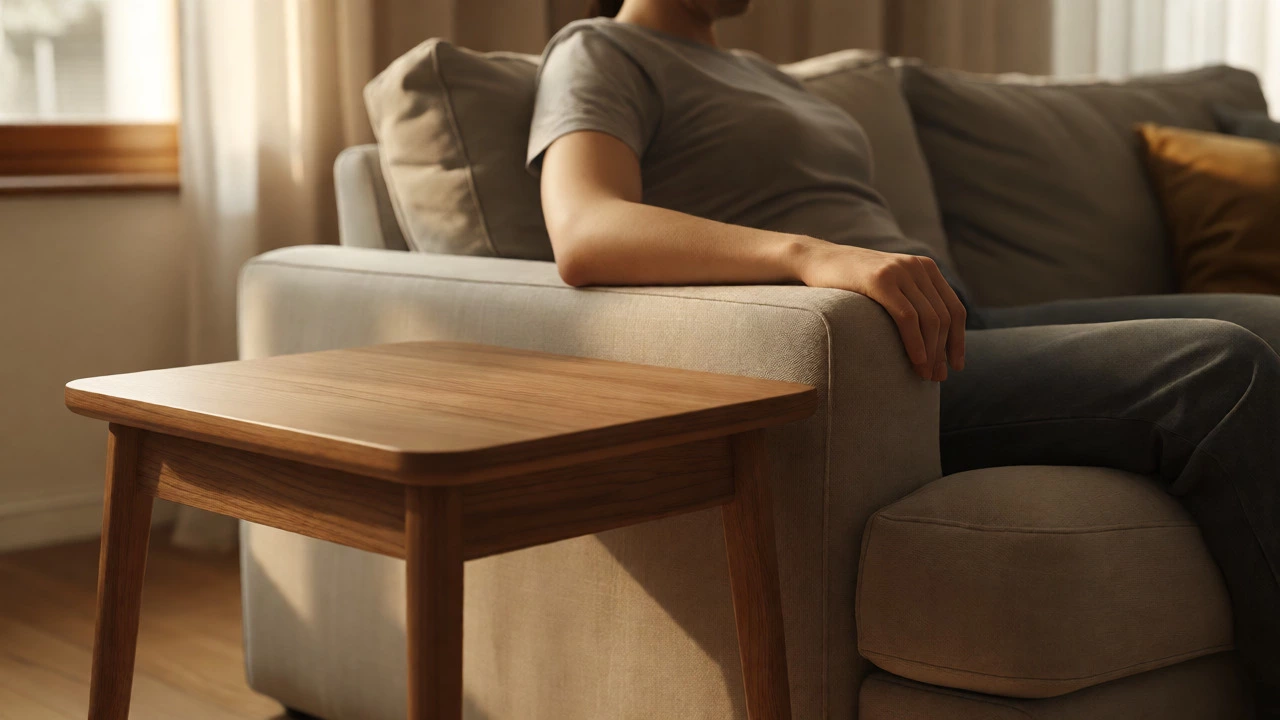
Here is the rule of thumb every interior designer uses: your end table surface should be within two inches of the height of your sofa’s armrest. Ideally, it should match the armrest height exactly or be up to two inches lower. Why? Because when you sit on your couch, your elbow naturally rests at about the same level as the armrest. If the table is significantly higher, you have to lift your shoulder to place a drink down, which creates tension. If it’s too low, you have to lean forward or stretch your arm out, which looks sloppy and feels unstable.
Think about the mechanics of sitting. When you settle into a couch, your body seeks support. The armrest provides lateral support for your arms. The end table provides vertical support for objects. If those two points don’t align, your body has to compensate. A table that is five inches higher than the armrest forces you to raise your hand unnecessarily. A table that is ten inches lower makes it hard to grab your phone without twisting your torso. The sweet spot is minimal effort. You want to be able to drop a book or a remote onto the table without looking, relying solely on muscle memory and spatial awareness.
Why Matching Armrest Height Matters More Than Seat Height
A common mistake people make is measuring from the floor to the seat cushion. Don’t do that. Measure from the floor to the top of the armrest. The seat height varies wildly depending on whether you have a modern, low-profile sofa or a traditional, overstuffed sectional. However, the relationship between the armrest and the adjacent table remains constant regardless of seat depth.
Consider the visual line. When you walk into a room, your eye travels across horizontal planes. If your sofa arm is at 24 inches and your end table is at 30 inches, you create a jagged, uneven skyline. It disrupts the flow of the room. Conversely, if both are at 24 inches, you get a clean, continuous line that makes the space look larger and more intentional. This visual continuity is crucial for making small rooms feel bigger and large rooms feel cohesive.
| Sofa Type | Typical Armrest Height | Recommended Table Height | Design Rationale |
|---|---|---|---|
| Traditional Chesterfield | 26-28 inches | 24-28 inches | Maintains classic symmetry; allows easy access to drinks. |
| Modern Low-Profile | 18-22 inches | 18-22 inches | Keeps sightlines open; prevents bulky look in small spaces. |
| Oversized Sectional | 24-26 inches | 22-26 inches | Ensures reachability from deep seats; matches massive scale. |
| Recliner Chair | Variable (often hidden) | Match mechanism height | Avoids blocking recline function; ensures stability. |
When Higher Is Better (And When Lower Works)
While matching height is the standard, there are exceptions where going higher or lower actually improves the design. Sometimes, breaking the rule is the right move if you know why you’re doing it.
Go Higher For Storage and Display: If you have a very low, sleek modern sofa with thin arms, a matching low table might look flimsy. In this case, choosing a table that is 2-4 inches higher can add necessary visual weight. It also gives you more surface area for stacking books or displaying a lamp. Just ensure the table isn’t so tall that it blocks your view of the TV or the person sitting next to you. If you have a coffee table nearby, keep the end tables visually subordinate or equal to avoid cluttering the center of the room.
Go Lower For Safety and Childproofing: If you have toddlers or pets, a lower end table is safer. If a child bumps into a sharp corner at chest height, it hurts. If the table is below their eye level, accidents are less severe. Additionally, lower tables encourage you to use them for storage baskets rather than display items, keeping the visual field clear. This is particularly useful in homes with limited square footage, where a towering end table can make the room feel cramped.
How to Measure Correctly Before Buying
Don’t guess. Use a tape measure. Here is the exact process I recommend to my clients in Mississauga who are furnishing new builds or renovating older homes:
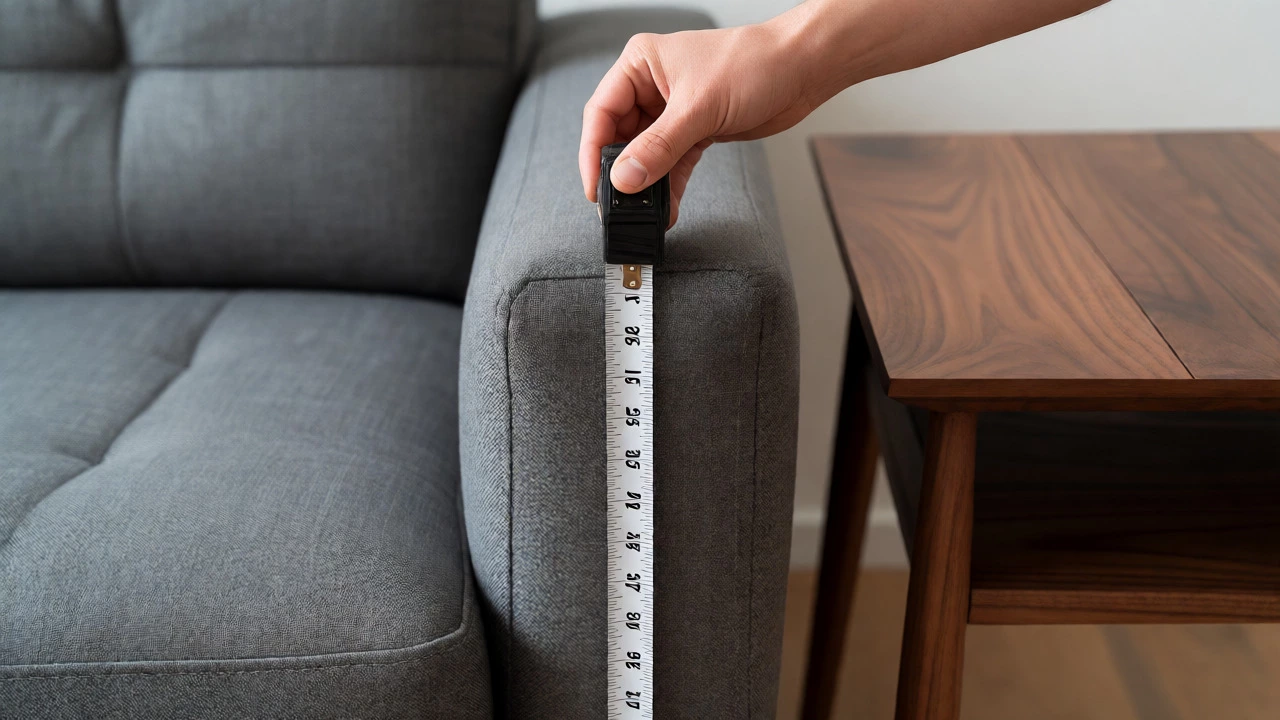
- Measure the Armrest: Place the end of the tape measure on the floor directly beneath the outer edge of the sofa arm. Pull it straight up to the highest point of the armrest. Note this number.
- Check the Depth: Measure how far the armrest protrudes from the back of the sofa. This determines the maximum depth of your end table. If the table is deeper than the arm, it will stick out awkwardly. If it’s shallower, it might wobble or not provide enough support for a heavy lamp.
- Account for Legs: Remember that many end tables have tapered legs or bases that flare out. Measure the widest part of the base to ensure it won’t hit the sofa leg or footrest.
- Test Reachability: Sit on the sofa. Extend your arm naturally. Does your hand hover over where the table would be? If you have to lean, the table is too far away or too low. If you have to lift your shoulder, it’s too high.

Material and Style Considerations
Height isn’t the only factor. The material of the end table affects how its height is perceived. A glass-top table at 24 inches looks lighter and less imposing than a solid oak table at 24 inches. If you choose a heavier material like marble or dark wood, you might want to go slightly lower to prevent it from feeling like a wall next to your couch. Conversely, if you choose delicate metal or acrylic, you can afford to go slightly higher because the visual weight is low.
Also, consider the function. Are you using the end table primarily for a charging station? Then you want it close enough to plug in devices easily. Are you using it for a reading lamp? Ensure the lamp shade doesn’t block your face when you’re sitting. A tall table with a short lamp works well here. A short table with a tall lamp might cast shadows in your eyes. These micro-decisions compound to create the overall vibe of the room.
Troubleshooting Common Mismatches
What if you already own the furniture and the heights don’t match? Don’t panic. You can fix this without buying new tables.
- Table Too High: Add a tray. Placing a shallow wooden or metal tray on top of a tall end table effectively lowers the usable surface by 1-2 inches. It also contains spills and adds texture.
- Table Too Low: Stack books. Use a stack of three or four hardcover books as a riser. Place your drink coaster on top of the books. This raises the effective height and adds personality.
- Wobbly Fit: If the table is the right height but hits the sofa arm, check if the sofa legs are splayed. Sometimes rotating the table 90 degrees solves the clearance issue.
Ultimately, the goal is comfort. Furniture should serve you, not the other way around. If you find yourself constantly adjusting your posture to reach your water, the height is wrong. Trust your body’s feedback. The perfect end table height is the one that disappears from your consciousness because it works so seamlessly with your daily routine.
Should end tables be higher than the couch seat?
Yes, almost always. The end table should be roughly level with the armrest, which is typically 4-6 inches higher than the seat cushion. If the table were level with the seat, you’d have to lean forward excessively to use it, which is ergonomically poor.
Is it okay if the end table is shorter than the armrest?
It is acceptable if it is within 2 inches shorter. Anything more than 2 inches shorter becomes difficult to reach comfortably while seated. If it is significantly shorter, consider adding a tray or books to raise the functional surface height.
Do end tables need to match the coffee table height?
Not necessarily. Coffee tables are usually lower than end tables because they are further from the seating position. However, they should not be drastically different in style or material, as this can create visual discord. Aim for a coordinated look rather than identical measurements.
What if my sofa has no visible armrests?
If you have an armless sofa or a modular sectional, measure from the floor to the top of the back cushion or the natural resting height of your elbow when seated. Typically, aim for 20-24 inches for modern low-profile sofas, even without defined arms.
Can I mix different end table heights?
Yes, mixing heights can add interest, especially in a sectional setup. Just ensure each individual table still respects the armrest height rule for the specific seat it accompanies. Avoid having one table 5 inches higher and another 5 inches lower, as this looks chaotic.