
Lift Chair Medicare Cost Calculator
How Medicare Coverage Works
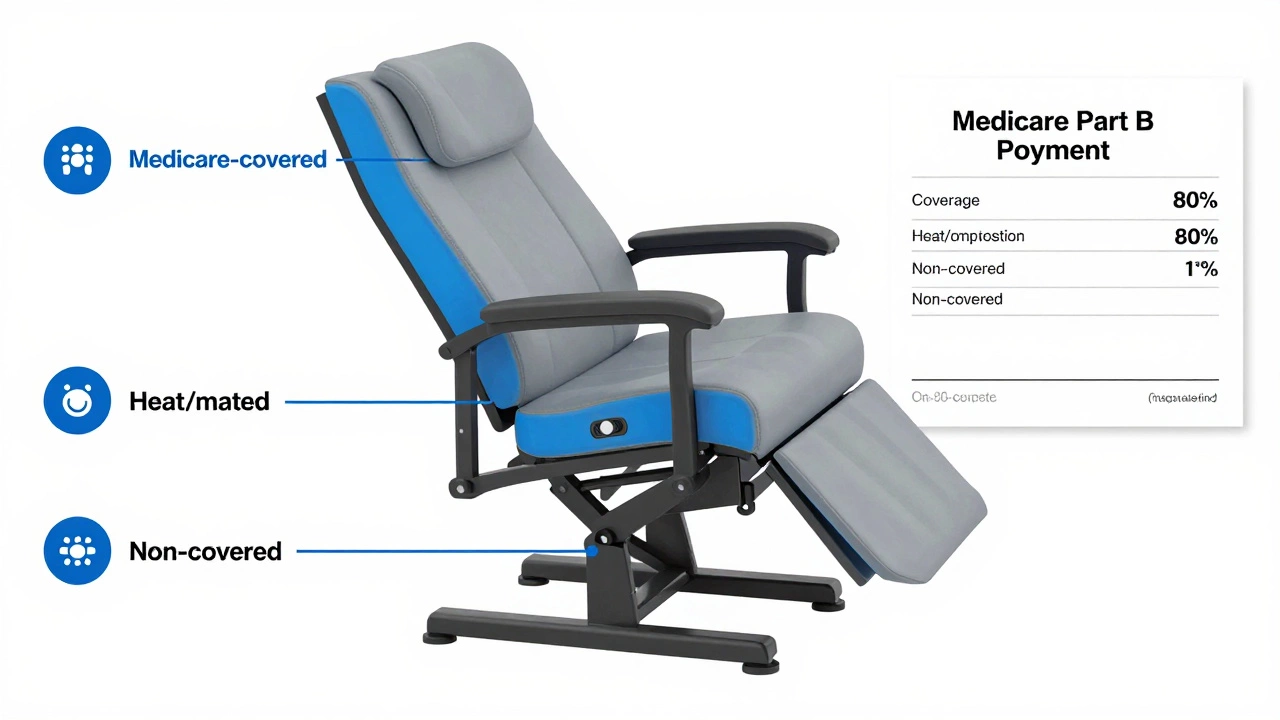
Medicare Part B covers 80% of the approved amount for the lift mechanism only, not the entire chair. You're responsible for 20% of the lift mechanism cost plus the full price of the chair frame, fabric, and any extra features.
If you’re struggling to stand up from your favorite chair, a lift chair might be the solution. But before you buy one, you’re probably wondering: Medicare will cover part of it - but how much?
The short answer: Medicare Part B pays 80% of the approved amount for the lift mechanism in a lift chair, after you meet your annual deductible. That means you’re responsible for the remaining 20%, plus the cost of the chair frame, fabric, and any extra features like heat or massage - none of which Medicare covers.
Let’s break this down so you know exactly what you’re paying for - and what you’re not.
What Is a Lift Chair, Anyway?
A lift chair is a type of recliner with a motorized mechanism that gently raises the entire seat to help you stand up. It’s not just a fancy recliner - it’s classified by Medicare as a durable medical equipment (DME) because it’s used for a medical purpose, like mobility impairment due to arthritis, severe joint pain, or muscle weakness.
Not all recliners qualify. If it doesn’t have a lifting mechanism that helps you transition from sitting to standing, Medicare won’t consider it eligible. You need a chair with a motorized lift system that moves the entire seat upward, not just a footrest or reclining function.
How Much Does Medicare Actually Pay?
Medicare Part B covers only the lift mechanism - the part that does the actual lifting. That’s it. The rest - the frame, upholstery, cushioning, armrests, and any added features like heat or vibration - are considered non-covered items.
For example, if a lift chair costs $1,200 total, and Medicare determines the lift mechanism is worth $600, then Medicare pays 80% of $600 = $480. You pay the other $120 for the lift part, plus the full $600 for the chair frame and fabric - so your out-of-pocket cost is $720.
Medicare doesn’t pay a flat percentage of the total price. It pays a percentage of the allowed amount for the lift component only. That allowed amount is set by Medicare’s fee schedule and varies by region and supplier.
What Do You Need to Qualify?
You can’t just walk into a store, buy a lift chair, and get reimbursed. There are rules.
- You must have a face-to-face evaluation with your doctor or a qualified healthcare provider.
- Your doctor must write a detailed prescription stating you have a medical condition that makes it difficult or unsafe to stand from a regular chair - like severe osteoarthritis, neuromuscular disease, or advanced mobility limitations.
- The lift chair must be purchased from a Medicare-enrolled DME supplier.
- You must rent or buy the chair from a supplier who accepts Medicare assignment - meaning they agree to accept Medicare’s approved payment as full payment for the lift mechanism.
If your supplier doesn’t accept assignment, you could end up paying the full price upfront and then filing a claim - but even then, Medicare will only reimburse up to their allowed amount for the lift mechanism, not the full retail cost.
What’s Not Covered?
Medicare won’t pay for any of these, even if they’re built into the same chair:
- Heat or massage functions
- Special fabrics or leather upholstery
- Custom color options
- Remote controls with extra features
- Extended warranties
- Delivery or setup fees
Some suppliers bundle these features into one price - which makes it hard to tell what’s covered and what isn’t. Always ask for a detailed breakdown of the cost: what’s the lift mechanism? What’s the chair? What’s extra?
How to Find a Medicare-Approved Supplier
Not every furniture store sells Medicare-eligible lift chairs. You need a DME supplier who’s enrolled in Medicare.
You can search for one using Medicare’s official supplier directory. Just go to Medicare.gov, click on “Find a Supplier,” and search by your zip code and the term “lift chair” or “durable medical equipment.”
Call the supplier first. Ask: “Do you accept Medicare assignment for lift chairs?” If they say yes, confirm they’ll handle the paperwork - including the prescription, certification, and claim submission. You don’t want to be stuck filing claims yourself.
Some suppliers offer “Medicare-ready” models - chairs with clearly labeled lift mechanisms and transparent pricing. These are your safest bets.
What If You Can’t Afford the 20%?
Medicare doesn’t cover the 20% coinsurance. That’s where supplemental insurance comes in.
If you have a Medigap plan (Medicare Supplement Insurance), most plans will cover that 20% coinsurance - so you pay nothing out of pocket for the lift mechanism. Check your policy. If you’re on Medicaid, you might qualify for full coverage through dual eligibility.
If you don’t have extra coverage, some suppliers offer payment plans or discounts for seniors. Nonprofits like Area Agencies on Aging sometimes help with grants for mobility equipment. Local charities or religious organizations may also assist.

How Often Can You Get a New One?
Medicare will only pay for one lift chair every five years - unless you can prove your old one is beyond repair or your medical condition has changed significantly. That’s why it’s worth investing in a durable model with a good warranty.
Don’t assume you can upgrade every time you want a new color or more features. Medicare’s five-year rule applies to the lift mechanism, not the whole chair. If your frame breaks but the lift still works, you’ll have to pay for a new chair yourself.
Real-Life Example
Sarah, 72, from Mississauga, has severe knee osteoarthritis. Her doctor prescribed a lift chair after she fell trying to stand from her old recliner. She bought a model priced at $1,400. The supplier broke it down: $750 for the lift mechanism, $650 for the chair frame and fabric.
Medicare’s approved amount for the lift mechanism was $680. Medicare paid 80% of that - $544. Sarah paid $136 for the lift part, plus $650 for the chair - total out-of-pocket: $786. Her Medigap plan covered the $136, so she paid nothing.
Without Medigap, she’d have paid $786. With it, she paid $0 for the covered part.
Bottom Line: Know What You’re Paying For
Medicare doesn’t pay for a lift chair - it pays for the lift mechanism, and only 80% of that. You’re still paying for the rest of the chair, and everything extra.
If you’re eligible, get the prescription, find a Medicare-approved supplier, and ask for a line-item cost breakdown. Don’t let marketing blur the line between medical necessity and luxury features.
With the right steps, you can get the mobility you need without overpaying. And if you have supplemental insurance, you might walk away with a new lift chair for free - not bad for a chair that helps you stand up without pain.
Does Medicare cover the whole lift chair or just the lifting part?
Medicare only covers the motorized lift mechanism, not the chair frame, fabric, or any added features like heat or massage. You pay for everything else out of pocket.
How much does Medicare pay for a lift chair?
Medicare Part B pays 80% of the approved amount for the lift mechanism only - not the full price of the chair. The approved amount is set by Medicare’s fee schedule and usually ranges from $500 to $800, depending on your region and supplier.
Do I need a prescription to get Medicare coverage?
Yes. You need a face-to-face evaluation with your doctor and a written prescription stating you have a medical condition that makes standing from a regular chair unsafe or impossible. The prescription must be dated before the chair is delivered.
Can I buy a lift chair online and still get Medicare coverage?
Only if you buy from a Medicare-enrolled DME supplier who accepts assignment. Many online retailers aren’t enrolled. Always verify the supplier’s Medicare status before purchasing - otherwise, you’ll pay full price and won’t get reimbursed.
How often can I get a new lift chair through Medicare?
Medicare will cover one lift chair every five years, unless your current one is damaged beyond repair or your medical condition has changed significantly. You can’t upgrade just because you want a different color or more features.
What if I don’t have Medigap? Can I still afford it?
Yes. Some suppliers offer payment plans. Local Area Agencies on Aging, nonprofit organizations, and charities sometimes provide grants or financial help for mobility equipment. Check with your local senior center or social services office.
Are lift chairs the same as power recliners?
No. Power recliners tilt back and raise the footrest but don’t lift the entire seat to help you stand. Only chairs with a full-seat lifting mechanism qualify as durable medical equipment under Medicare.
Can I rent a lift chair instead of buying one?
Yes. Medicare covers rental of lift chairs for up to 13 months. After that, you own it. Renting can be a good option if your condition is temporary or you’re unsure if you’ll use it long-term.