65" TV Height Calculator
Calculate Your Perfect TV Height
Determine the optimal height for your 65-inch TV based on your viewing posture and setup.
How It Works
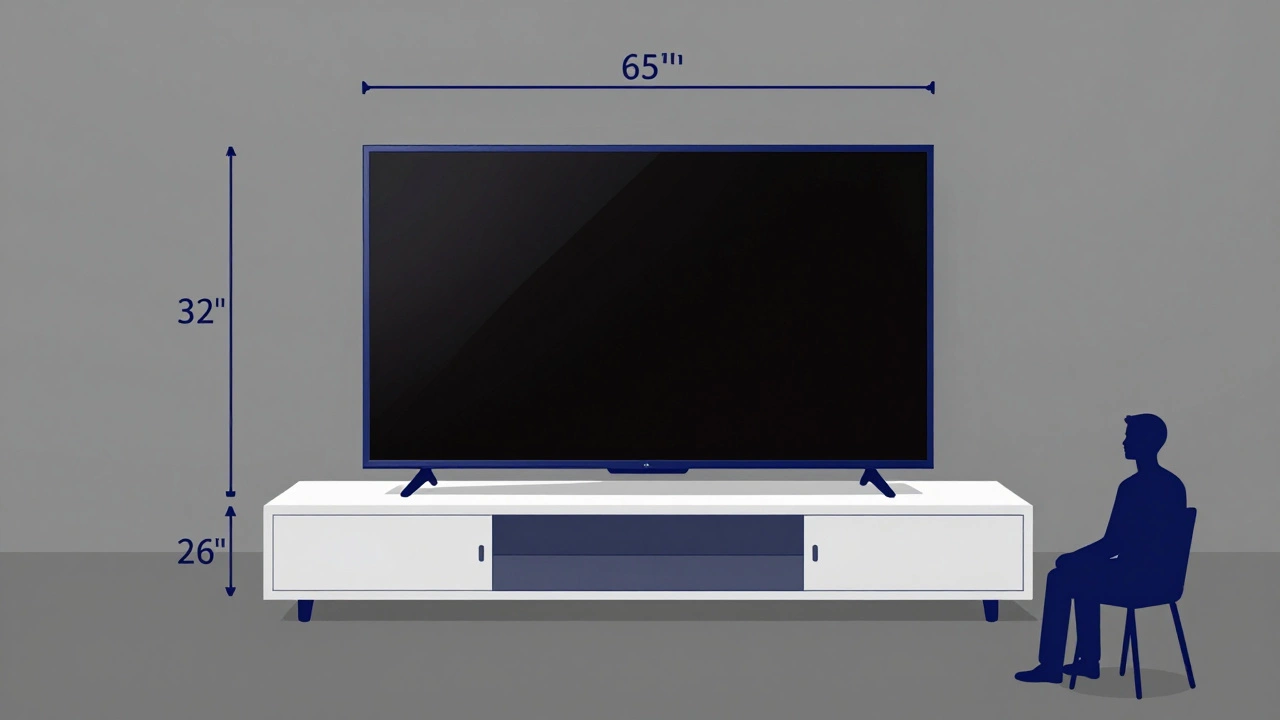
For a 65-inch TV, the screen height is approximately 32 inches. To find the optimal height:
- Center of screen should match your eye level
- Subtract 16 inches from your eye level to find the bottom of the TV
- Account for soundbars and stands that affect height
Important: Always measure from the floor to your eyes when seated in your regular viewing position. This is your reference point.
Optimal TV Height Settings
Enter your measurements to see your results.
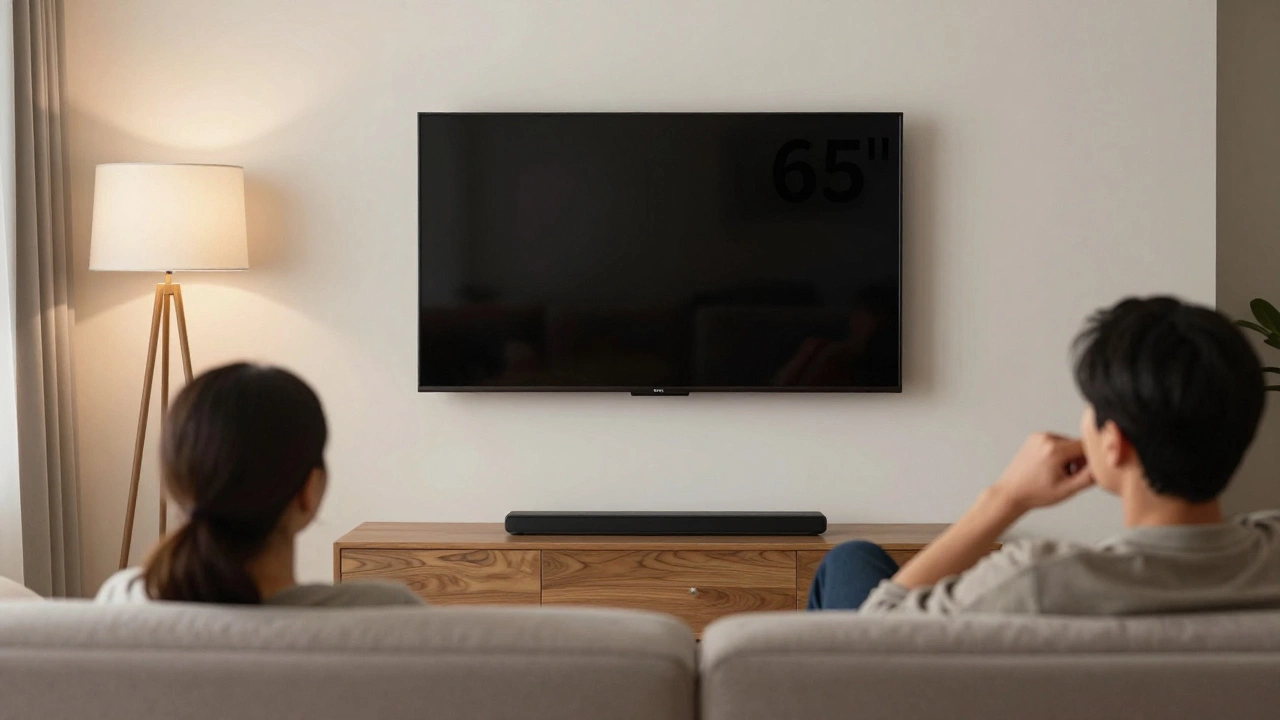
When you buy a 65-inch TV, you’re not just buying a screen-you’re buying an experience. But if the TV is mounted too high or too low, that experience turns into a neck ache. So what’s the best height for a 65-inch TV? The answer isn’t about the TV’s size alone. It’s about your eyes, your couch, and how you sit.
Start with eye level
The golden rule for TV height? The center of the screen should be at eye level when you’re sitting down. This isn’t a suggestion from a marketing brochure-it’s backed by decades of ergonomic research from the Society of Motion Picture and Television Engineers (SMPTE). For most people, that means the middle of the screen lands about 42 inches above the floor.
Why? Because your eyes naturally rest about 40 to 45 inches off the ground when seated on a standard couch. If your TV is mounted higher, you’re looking up-straining your neck. Too low, and you’re looking down, which can cause shoulder tension over time. A 65-inch TV has a screen height of roughly 32 inches. That means the bottom edge sits around 26 inches from the floor, and the top is near 58 inches. The center, then, lands right at 42 inches.
TV stand height matters more than you think
If you’re using a TV stand instead of wall-mounting, the stand’s height becomes critical. Most standard TV stands are 18 to 20 inches tall. That’s perfect. Add the 32-inch screen height, and the center of the screen ends up at 40 to 42 inches-right where it should be.
But here’s where people mess up: they buy a tall media console or stack a soundbar on top of the stand. Suddenly, the TV is 25 inches higher than it should be. Now you’re staring up at the bottom of the screen. That’s not just uncomfortable-it’s bad for your posture. A 2023 study from the University of Toronto’s Human Factors Lab found that viewers using TVs mounted more than 6 inches above eye level reported 67% more neck discomfort after just 30 minutes of viewing.
What if you’re sitting on a higher couch?
Not everyone sits on a standard 18-inch couch. If you have a deep-seated sectional, a recliner, or a floor cushion setup, your eye level changes. Measure it. Sit in your usual spot, relax your posture, and have someone measure from the floor to your eyes. That’s your target height.
For example, if you sit with your eyes at 48 inches off the ground, the center of your 65-inch TV should be at 48 inches. That means your TV stand needs to be 32 inches tall (48 minus 16, since half of 32 is 16). You won’t find many stands that tall, so you’ll need to elevate the TV with a riser or consider wall-mounting higher up.
Wall mounting? Adjust for depth and angle
Wall mounting gives you more control, but it’s easy to get it wrong. A common mistake? Mounting the TV too high because you think it looks "prettier" on the wall. Don’t. Even if your TV is on a 55-inch wall-mounted shelf, the center still needs to be at eye level.
Also, consider the viewing angle. If your TV is mounted high and you’re sitting far back, you might be looking down at a steep angle. That causes glare and distorts the image. The ideal viewing angle is 15 degrees or less from horizontal. For a 65-inch TV, that means sitting 7 to 9 feet away. If you’re closer, lower the TV. If you’re farther, you can raise it slightly-but never above eye level.
Soundbars and accessories can throw things off
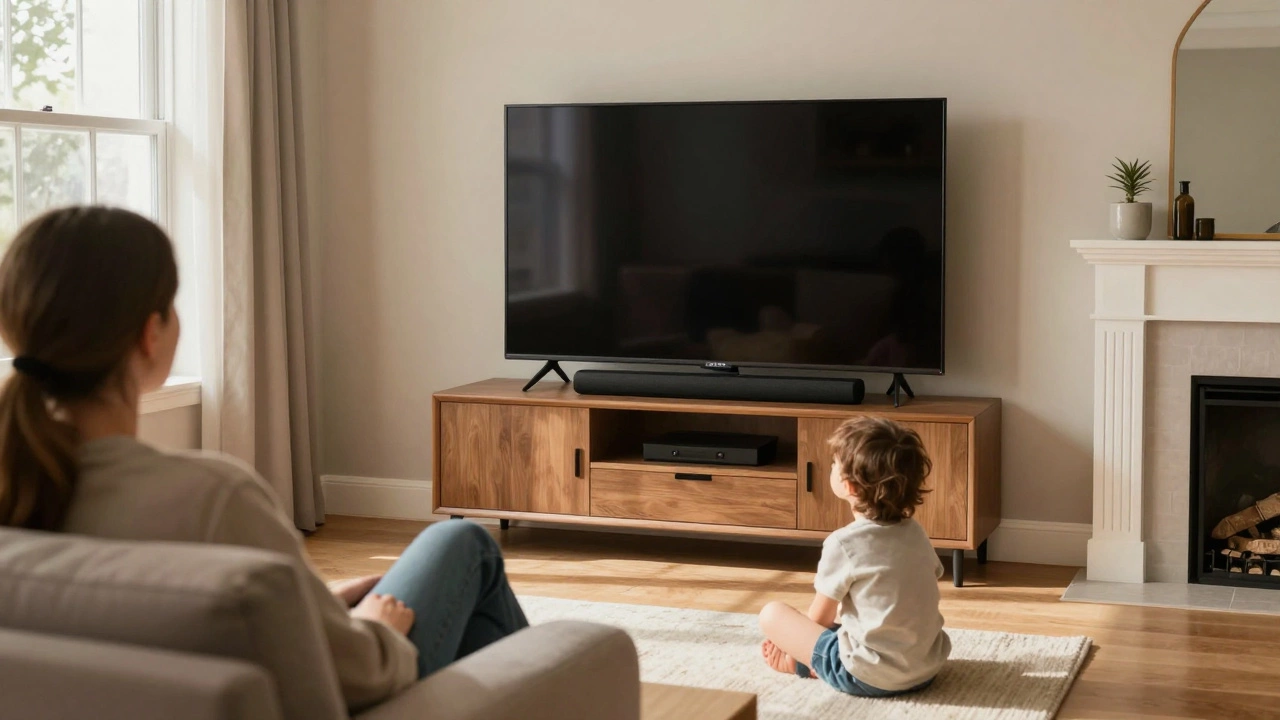
Soundbars are popular, but they’re also a silent killer of proper TV height. Most soundbars are 3 to 5 inches tall. If you put one under your TV, you’re lifting the screen by that much. That might push the center of the screen 2 to 3 inches above eye level.
Here’s what to do: mount the soundbar below the TV, not under it. Use a wall bracket that attaches to the TV’s VESA mount and hangs the soundbar independently. Or, if you’re using a stand, place the soundbar in front of the TV, not under it. This keeps the TV’s center at the right height without sacrificing sound quality.
What about kids or standing viewers?
If you have young kids who sit on the floor, or if you often stand while watching (like when cooking in an open kitchen), you’re dealing with multiple eye levels. In those cases, compromise is key. Aim for the height that works best for your most common viewing position-usually seated.
For families, a 40- to 44-inch center height usually covers most scenarios. Kids on the floor will look up a little, but not enough to cause strain. Adults sitting will be fine. Standing viewers might need to tilt their heads slightly, but that’s unavoidable unless you install a motorized lift-which most people don’t need.
How to measure your ideal TV height
Follow this simple 3-step process:
- Sit in your usual viewing spot with your regular posture.
- Have someone measure from the floor to your eyes. Write it down.
- Subtract 16 inches (half of 32, the screen height of a 65-inch TV). That’s the ideal height for the bottom of your TV.
Example: Your eye level is 42 inches. 42 minus 16 = 26 inches. So the bottom of your TV should sit 26 inches above the floor. That means your stand should be 26 inches tall-or you’ll need to adjust your mount accordingly.
Common mistakes to avoid
- Putting the TV on a tall entertainment center without checking the center height.
- Mounting the TV above a fireplace-unless you’re okay with a stiff neck.
- Using a stand that’s too short, making the TV look like it’s floating on the floor.
- Ignoring the TV’s bezel. The screen height doesn’t include the frame, so always measure from the bottom of the screen, not the bottom of the TV.
- Assuming all 65-inch TVs are the same. Some have thicker bezels or different mounting points. Always check the product specs for exact screen dimensions.
Real-world example from Mississauga
A neighbor in Mississauga installed a 65-inch TV on a 24-inch stand with a 4-inch soundbar underneath. The center of the screen ended up at 46 inches. He complained of neck pain after every movie night. We moved the soundbar to the front, lowered the stand by 4 inches, and the center dropped to 42 inches. His neck pain disappeared. He didn’t spend a dime-just adjusted the setup.
Final tip: Test before you commit
Before you drill holes or buy a new stand, try this: Tape a piece of paper to the wall at your calculated eye level. Sit back and look at it for 20 minutes. If your neck feels relaxed, you’ve got it right. If you’re tilting, adjust up or down by 2 inches and test again. It’s the cheapest and most effective way to get it perfect.
There’s no magic number that works for everyone. But if you start with eye level, adjust for your couch, and avoid stacking gear on top of your TV, you’ll be watching in comfort for years.
Is 42 inches the right height for a 65-inch TV for everyone?
Not exactly. 42 inches is the average eye level for most adults sitting on standard couches. But if your seating is higher or lower-like a recliner, floor cushion, or high-back chair-you need to measure your own eye level and subtract 16 inches. That’s your ideal bottom-of-TV height.
Can I mount a 65-inch TV above my fireplace?
Technically yes, but it’s not recommended. Fireplaces often place the TV center at 50+ inches, forcing you to look up. That causes neck strain over time. Plus, heat from the fireplace can damage electronics. If you must mount it there, use a tilting bracket to angle the screen down slightly and keep viewing angles under 15 degrees.
Does a soundbar raise the TV height?
Yes, if you place it under the TV. A 4-inch soundbar lifts the TV’s center by 2 inches. To avoid this, mount the soundbar independently on the wall or place it in front of the TV stand. Never let it sit directly under the screen if you care about proper eye level.
What if my TV stand is too short?
If your stand is too short, the TV will sit too low. Use a riser-something sturdy like a wooden block or a purpose-built TV platform. Avoid stacking boxes or unstable items. A 4- to 6-inch riser can make all the difference without needing to buy a new stand.
How far should I sit from a 65-inch TV?
For the best viewing experience, sit between 7 and 9 feet away. This keeps the screen filling your field of view without causing eye strain. If you sit closer than 6 feet, the image might feel overwhelming. If you’re farther than 10 feet, you’ll lose detail. Adjust your TV height based on this distance too-closer viewers should have the TV lower.