Office Chair 80/20 Feature Checker
Check Your Chair Features
Use this tool to verify if your office chair meets the essential 20% of features for comfort and support according to the Pareto Principle.
Most people buy office chairs based on looks, brand names, or what’s on sale. But if you’re spending eight hours a day in that chair, why are you treating it like an afterthought? The 80/20 rule-also called the Pareto Principle-says that 80% of your results come from 20% of your efforts. Applied to office chairs, that means 80% of your comfort, posture, and productivity comes from just 20% of the features you actually use. Stop wasting money on flashy extras. Focus on what matters.
What the 80/20 Rule Really Means for Your Chair
You don’t need a chair with 15 adjustments, memory foam lumbar pillows, or Bluetooth speakers. You need a chair that supports your spine, lets you move naturally, and doesn’t break after six months. The 80/20 rule tells you to find those five key features that deliver 80% of the benefit. Everything else is noise.
Think of it like cooking. You don’t need 20 spices to make a great meal. Salt, oil, garlic, heat, and time-that’s your 20%. The rest just adds complexity. Same with chairs. The right height, proper lumbar support, adjustable armrests, breathable material, and a sturdy base? That’s your 20%. Everything else is decoration.
The 20% of Features That Matter Most
- Seat height adjustment - Your feet should rest flat on the floor, knees at 90 degrees. If you can’t adjust this, you’re sitting wrong. No exceptions.
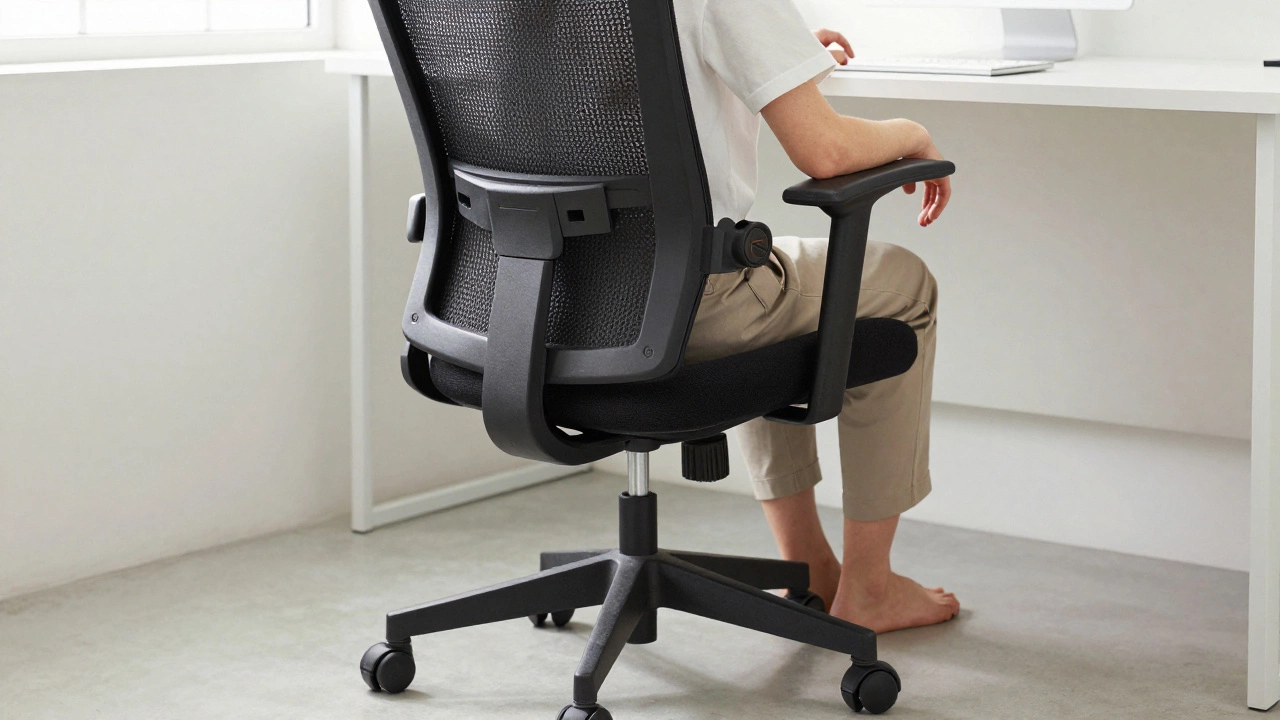
- Lumbar support - Not just a pillow. It needs to lock into place and match the curve of your lower back. A chair without this forces your spine into a C-shape. That’s how you get chronic lower back pain.
- Adjustable armrests - Arms should rest lightly, shoulders relaxed. If your armrests are fixed or too high, you’re shrugging your shoulders all day. That leads to neck strain and headaches.
- Breathable mesh back - Synthetic fabrics trap heat. Mesh lets air flow. You’ll sweat less, sit longer, and stay focused. This isn’t a luxury-it’s a necessity in a 40-hour workweek.
- Sturdy five-point base with smooth wheels - A wobbly base or stiff casters ruin everything. You need to roll easily without tipping. Look for a base rated for at least 250 lbs. and wheels that roll on both carpet and hard floors.
These five features are non-negotiable. If a chair doesn’t have them, it doesn’t belong in your home office-even if it costs $500 and has a name like “ErgoPro Max Ultra.”
What You Can Skip (And Save Money On)
Here’s what most people waste money on:
- Heated seats - You’re not sitting in a sauna. Your body generates enough heat.
- Memory foam cushions - They compress over time and lose support. Mesh is more durable and cooler.
- Multiple recline angles - If you’re working, you need to sit upright. Reclining is for breaks, not tasks.
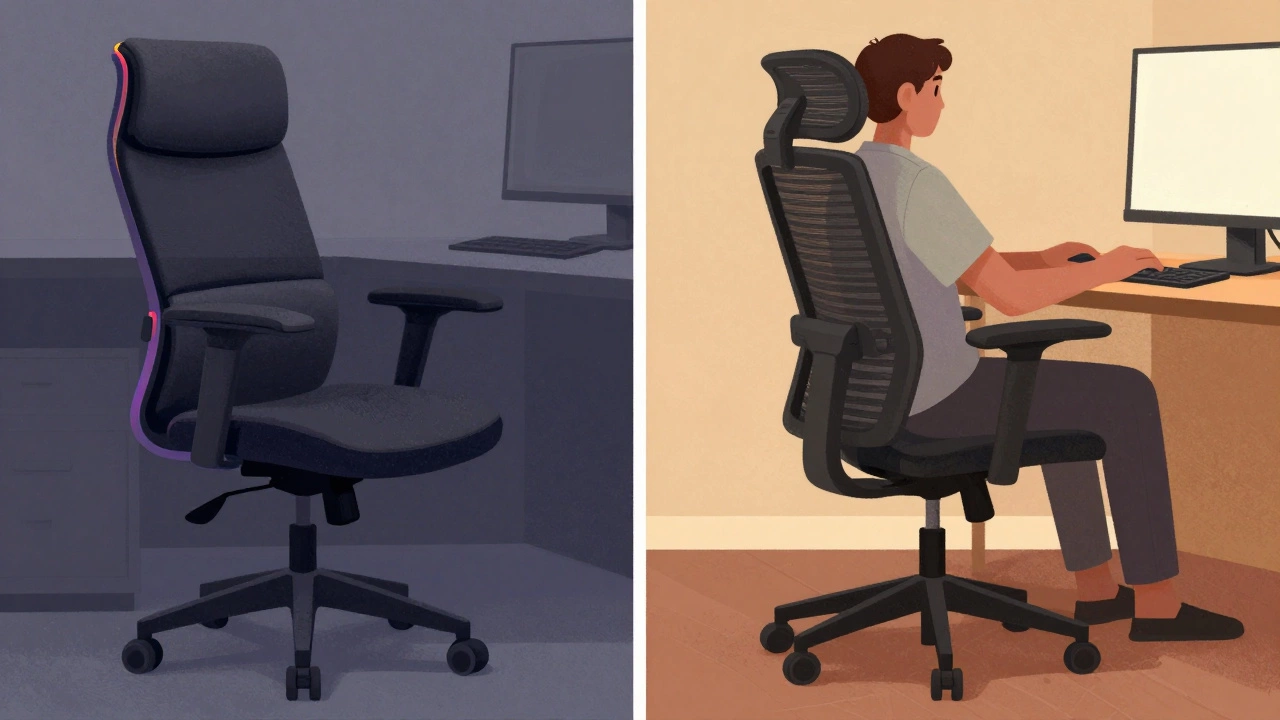
- Headrests - Unless you’re napping at your desk, you don’t need one. They often force your neck forward.
- RGB lighting - It looks cool in a TikTok video. It does nothing for your posture.
These features make marketing brochures look impressive. They don’t make you more comfortable or productive. In fact, they often make the chair heavier, bulkier, and harder to adjust.
Real-World Example: The 0 Chair That Outperforms 0 Models
A client in Mississauga bought a Steelcase Leap v2 because it was recommended by a corporate HR department. It cost $800. After three months, he complained about his lower back still hurting. He didn’t know how to adjust the lumbar support. The chair had it-but he never moved the dial.
He switched to a Herman Miller Aeron (used, $350). Still too much. Then he tried a Amazon Basics High-Back Executive Chair-$120. He adjusted the height, locked the lumbar into place, and kept the armrests at elbow level. Within a week, his back pain dropped by 70%.
It wasn’t the brand. It wasn’t the price. It was the 20%: height, lumbar, arms, mesh, base. He used those. Everything else? He ignored it.
How to Test a Chair Before You Buy
You can’t trust product descriptions. You need to test the 20% yourself.
- Set the seat height. Can you sit with feet flat and knees bent at 90 degrees? If not, skip it.
- Press your lower back into the chair. Does the lumbar support push back naturally? Or does it feel like a plastic bump?
- Rest your arms. Do your shoulders drop? Or do you have to lift them to reach the desk?
- Lean back slightly. Does the chair feel stable? Or does it wobble like a lawn chair?
- Run your hand over the backrest. Is it mesh? Or is it plastic-coated fabric that feels sticky?
If it passes all five, it’s worth buying-even if it’s the cheapest option on the shelf.
Why Most People Get This Wrong
Marketing trains us to think more features = better. But in furniture, especially chairs, complexity is the enemy of comfort. A chair with 10 adjustments is only useful if you know how to use all 10. Most people don’t. They set it once and forget it.
That’s why the 80/20 rule works: it forces you to simplify. You’re not buying a chair to impress your Zoom guests. You’re buying it to survive your workday without pain.
Studies from the University of Waterloo’s Human Factors Lab show that workers using chairs with basic ergonomic adjustments (height, lumbar, arms) reported 42% fewer days off due to back pain over a 12-month period. The chairs didn’t have to be expensive. They just had to be adjustable in the right places.

Your Action Plan: The 80/20 Chair Checklist
Before you click “Buy Now,” run through this:
- ✅ Can I adjust the seat height to get my feet flat on the floor?
- ✅ Does the lumbar support lock into my lower back’s natural curve?
- ✅ Can I adjust the armrests so my shoulders are relaxed?
- ✅ Is the backrest made of breathable mesh (not padded fabric)?
- ✅ Does the base have five wheels and feel solid when I shift my weight?
If all five are yes, buy it. If even one is no, keep looking. You don’t need to spend $500. You just need to spend wisely.
What Happens When You Ignore the 80/20 Rule
People who buy chairs based on looks or price end up with:
- Chronic lower back pain by month three
- Shoulder tension from fixed armrests
- Headaches from slouching
- Discomfort so bad they work from the couch
- And then they buy another chair. And another.
It’s a cycle. And it’s avoidable. The 80/20 rule isn’t about saving money-it’s about stopping the waste. Your body isn’t disposable. Your chair shouldn’t be either.
Is the 80/20 rule only for expensive office chairs?
No. The 80/20 rule applies to chairs at any price. A $100 chair with proper height adjustment, lumbar support, mesh back, and a stable base will outperform a $700 chair that lacks those five key features. It’s not about cost-it’s about function.
Can I use a dining chair as an office chair?
Not for long. Dining chairs lack height adjustability, lumbar support, and armrests. Sitting on one for 6+ hours a day increases risk of back strain, poor circulation, and shoulder pain. It’s a temporary fix at best.
How long should a good office chair last?
A chair built with quality materials and the right adjustments should last 7-10 years. Look for warranties of 10+ years-brands that offer them stand behind their product. If a chair has a 2-year warranty, it’s likely made for short-term use.
Do I need a headrest on my office chair?
Only if you take long breaks or nap at your desk. For focused work, a headrest forces your neck forward, which strains your upper back and triggers headaches. Skip it unless you use it regularly.
What’s the best brand for 80/20 office chairs?
There’s no single best brand. Herman Miller, Steelcase, and Humanscale make excellent chairs, but so do budget options like Amazon Basics, Flash Furniture, and OFM. Focus on the five key features, not the logo. A $150 chair with proper adjustments beats a $600 chair with broken lumbar controls.
Final Thought: Your Chair Is an Investment in Your Body
You wouldn’t buy a car without checking the brakes. Yet people buy office chairs without testing the support. The 80/20 rule cuts through the noise. It reminds you that comfort isn’t about features-it’s about function. Focus on the five things that matter. Ignore the rest. Your back will thank you for years to come.