Recliner Safety Assessment Tool
Answer these questions to determine if a recliner meets senior safety standards based on expert recommendations.
Results will appear here after assessment
When you’re over 65, sitting down shouldn’t feel like a chore. Yet many seniors struggle with stiff hips, sore lower backs, or weak leg muscles just trying to get up from a regular chair. That’s where recliners come in - but are they actually good for seniors? The answer isn’t simple. Some recliners can be a game-changer. Others? They’re just another hazard waiting to happen.
Why Recliners Can Be a Lifesaver for Seniors
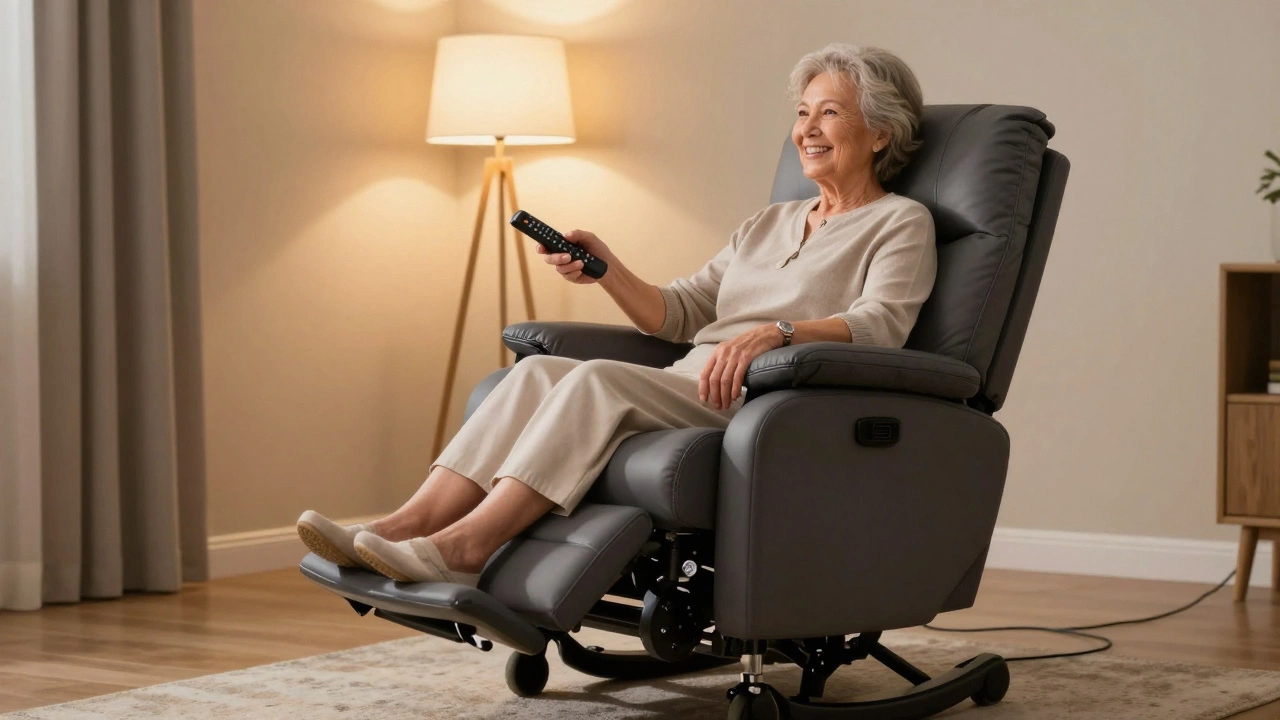
Let’s start with the positives. A well-designed recliner does more than let you kick back. It helps with circulation, eases pressure on joints, and supports the spine in a way most chairs don’t. A 2024 study from the Canadian Institute of Aging found that seniors who used recliners with proper lumbar and leg support reported 40% fewer lower back pain episodes over six months compared to those using standard dining chairs.
Here’s how recliners help in real life:
- Reduced joint strain - When your legs are elevated, pressure on your knees and hips drops significantly. That’s why many seniors with arthritis say they can sit longer without pain.
- Better blood flow - Elevating the legs helps prevent swelling in the ankles and feet, a common issue for older adults, especially those with heart or circulation conditions.
- Easier起身 (getting up) - Recliners with lift mechanisms use motors to tilt the chair forward, bringing you to a standing position. This cuts down on the need to push off with your legs - a huge help for those with weak quadriceps or balance issues.
- Improved breathing - For seniors with COPD or sleep apnea, reclining at a 30-45 degree angle can make breathing easier than lying flat or sitting upright.
One woman in Mississauga, 78, told me she hadn’t been able to sit in her old armchair for more than 20 minutes without needing to stand and stretch. After switching to a power recliner with heat and massage, she now watches her favorite shows for hours. "It’s the first time in years I’ve felt comfortable just sitting," she said.
The Hidden Risks: When Recliners Can Hurt More Than Help
Not all recliners are created equal. A poorly chosen one can increase fall risk, worsen posture, or even trap someone in a dangerous position.
Here are the biggest dangers:
- Too deep or too soft - If the seat is too deep, seniors can slide forward and struggle to push themselves up. A cushion that sinks too much makes it harder to generate the force needed to stand.
- No armrest support - Armrests should be sturdy and at the right height (between 20-22 inches from the floor). Weak or too-low armrests mean seniors can’t use them to brace themselves when standing.
- Power failures - Power recliners with lift features rely on electricity. If the power goes out, the chair might lock in a reclined position. That’s a serious risk if someone needs to get up quickly.
- Cluttered surroundings - Recliners with footrests and side controls can create tripping hazards if the floor around them isn’t clear. Loose rugs, extension cords, or cluttered side tables are common causes of falls.
A 2025 home safety audit by the Ontario Safety Council found that 32% of falls among seniors over 70 happened near recliners - not because the chair was faulty, but because it was placed too close to a doorway or beside a lamp with a dangling cord.
What to Look for in a Recliner for Seniors
Not every recliner on the market is right for an older adult. Here’s what to prioritize:
- Power lift function - Look for chairs with a motorized lift that raises the entire seat. This isn’t just a luxury - it’s a mobility aid. The best models have a gentle, slow motion and can lift up to 300 pounds.
- Firm seat cushion - Avoid memory foam that sinks too deep. A medium-firm cushion (at least 4 inches thick) gives support without trapping you.
- Adjustable backrest and footrest - You should be able to set the recline angle independently from the footrest. Some seniors need a slight recline with legs flat; others need full recline.
- Sturdy, wide armrests - Armrests should be thick enough to grip and at elbow height when seated. Look for padded, non-slip surfaces.
- Easy-to-reach controls - Buttons should be large, high-contrast, and not hidden behind cushions. Some models even have remote controls with voice assistance.
Also, check the chair’s weight capacity. Many standard recliners max out at 250 pounds. Seniors over 200 pounds need heavy-duty models designed for larger frames.
Power Recliners vs. Manual Recliners: Which Is Better?
There’s a big difference between a manual recliner (push-button or lever) and a power recliner (motorized). For seniors, power is almost always better.
| Feature | Power Recliner | Manual Recliner |
|---|---|---|
| Getting up | Lifts you to standing position | Requires leg strength and balance |
| Energy needed | Minimal - just press a button | High - arms and legs must work together |
| Control | Smooth, adjustable positioning | Fixed angles, hard to fine-tune |
| Power outage risk | Can get stuck - backup battery recommended | Always works, even without electricity |
| Price range | $800-$2,500 | $300-$900 |
If budget allows, go for a power recliner with a backup battery. Some models, like the La-Z-Boy Lift Power, include a 2-hour battery that activates during outages. That’s not a gimmick - it’s a safety feature.
Other Features That Make a Difference
Extra features aren’t just nice to have - they can be critical for comfort and safety.
- Heat and massage - Gentle vibration and warmth help relax tight muscles and improve circulation. Avoid strong massage settings - they can be too intense for sensitive skin or nerve conditions.
- Washable, breathable fabric - Look for performance fabrics like microfiber or solution-dyed polyester. They resist stains and don’t trap heat. Avoid leather - it can get too hot or cold and is harder to clean.
- Side pockets - For remote controls, glasses, or medication. Easy access reduces the need to get up.
- Wheels or glides - Some chairs have small wheels to make moving them easier. If you’re rearranging furniture, this helps. Just make sure they lock.
One man in Hamilton, 82, uses his recliner for naps after taking his blood pressure meds. His chair has a built-in timer that gently returns to upright after 30 minutes. "It keeps me from sleeping too long and getting dizzy," he said. "I didn’t even know that was a thing until my daughter showed me."
When to Avoid a Recliner Altogether
Not every senior should use a recliner. If you or a loved one has:
- Severe balance disorders or frequent falls
- Advanced dementia and tends to wander or get confused
- Skin conditions like pressure sores or open wounds
- Recent hip or spinal surgery (within 6 weeks)
…then a recliner might not be safe without medical clearance. In these cases, a zero-gravity chair or a specialized orthopedic chair with medical-grade support may be better.
Final Checklist: Is This Recliner Right?
Before buying, test it. Bring a senior along. Here’s your quick checklist:
- Can they sit down without help?
- Can they stand up without using their hands on the arms or legs?
- Do their feet rest flat on the footrest? (No dangling.)
- Is the back support at the curve of the lower spine?
- Can they reach the controls without stretching or twisting?
- Is there at least 2 feet of clear space around the chair?
If the answer to any of these is "no," keep looking. A recliner shouldn’t be a compromise - it should be an upgrade.
Are power recliners safe for seniors with weak legs?
Yes - if they have a lift function. Power recliners with lift features help seniors rise from a seated position without relying on leg strength. Look for models that lift the entire seat, not just tilt it forward. Always test the chair in person to ensure smooth operation.
Can recliners cause back pain?
They can, if they lack proper lumbar support. A recliner that doesn’t support the natural curve of the lower spine can cause slouching, which strains muscles over time. Choose a chair with adjustable lumbar support or a built-in contour that matches the spine’s shape.
How long should a senior sit in a recliner?
There’s no strict rule, but experts recommend changing positions every 30-45 minutes. Sitting too long in any chair - even a good one - can reduce circulation and increase pressure on the hips and tailbone. Use recliners for rest and recovery, not as a permanent seating solution.
Do Medicare or insurance cover recliners?
Medicare Part B may cover a lift chair if it’s prescribed as durable medical equipment (DME) for a medical condition like severe arthritis or mobility impairment. You’ll need a doctor’s note and to buy from a Medicare-approved supplier. Most standard recliners are not covered.
What’s the best fabric for a senior’s recliner?
Performance microfiber or solution-dyed polyester. These fabrics resist stains, don’t trap heat, and are easy to clean with a damp cloth. Avoid leather, velvet, or plush fabrics - they collect dust, get slippery, and are harder to maintain.
If you’re helping a senior choose a recliner, don’t just pick the cheapest or the fanciest. Look for one that lets them sit with dignity, move with ease, and rest without pain. The right recliner isn’t just furniture - it’s a tool for independence.